Choosing a robotic lawn mower used to be simple—bury a wire and let a small machine ping-pong around your lawn. Today, the market is flooded with advanced technologies including satellite navigation, computer vision, AI, and complex drive systems.
At Lawn Loop, as an authorized premium Kress retailer and professional installer, we help homeowners navigate these choices to find the exact setup for their unique landscapes. This guide breaks down the core technologies driving modern robotic mowers and explains why premium commercial-grade Kress solutions differ significantly from low-cost consumer alternatives. Buy a result, not just a Robot Lawnmower.
1. Boundary Systems: Wired vs. Wireless
Wired Systems (Perimeter Wire)
Wired robot mowers require a physical low-voltage wire buried around the boundary of your lawn and internal obstacles (flower beds, trees, ponds).
Pros: Highly reliable signals; unaffected by tall trees, dense canopies, or building shadows.
Cons: Labor-intensive installation; vulnerable to wire breaks from aeration, digging, or rodents; tedious to reconfigure if landscape design changes.
Wireless Systems (Boundary Wire-Free)
Modern wireless mowers use satellite technology (RTK-GNSS) or optical/vision tracking to establish digital boundaries.
Pros: Rapid virtual mapping; easy adjustments to boundaries and keep-out zones directly via a smartphone app.
Cons: Cheaper RTK models suffer signal degradation under tree canopies, near high walls, or during satellite multi-path interference. Premium systems like Kress RTKn overcome this through network-based positioning.
2. Drive Systems: All-Wheel Drive (AWD) vs. Two-Wheel Drive (2WD)
2WD (Two-Wheel Drive)
Most entry-level and mid-range mowers use two powered main wheels and one or two passive caster wheels.
Best For: Flat to mildly sloping yards (up to 20° / 35% incline).
Drawbacks: Can struggle on damp turf, rutted ground, or steep slopes, leading to wheel spinning, tearing up grass, or slipping outside virtual boundaries.
AWD (All-Wheel Drive)
AWD mowers utilize individual high-torque motors for each wheel, offering vastly superior traction and slope handling.
Best For: Complex, hilly terrain (up to 35°–45° / 70%–80% incline), rough terrain, and slippery conditions.
Advantages: Prevents turf damage during tight turns and handles wet or uneven grass smoothly without getting stuck.
3. Navigation & Intelligence: AI, Vision, Inertial Guidance & Dead Reckoning
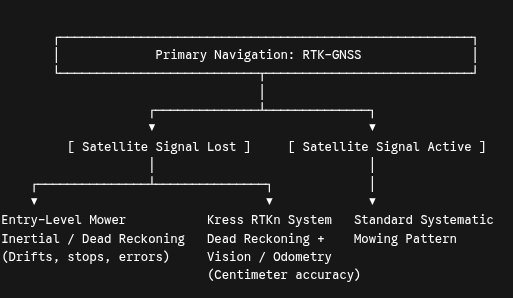
When a robot mower loses satellite sight (e.g., under a dense tree line), how it handles navigation separates basic consumer models from professional-grade technology.
Vision Technology & AI
Camera systems powered by artificial intelligence serve two primary purposes:
Obstacle Avoidance: Real-time detection and active avoidance of dynamic objects (toys, pets, garden tools, wildlife).
Boundary Perception: AI distinguishes between grass, mulch, gravel, and concrete, preventing the mower from straying even if GPS fails.
Inertial Guidance & Dead Reckoning
Inertial Measurement Units (IMUs): Gyroscopes and accelerometers track the mower’s movement, direction, and tilt.
Dead Reckoning: A method that calculates current position based on wheel rotations (odometry) and directional sensors when GPS signals are blocked.
Budget implementation: Drifts significantly over short distances, causing un-mown patches, endless spinning, or boundary overruns.
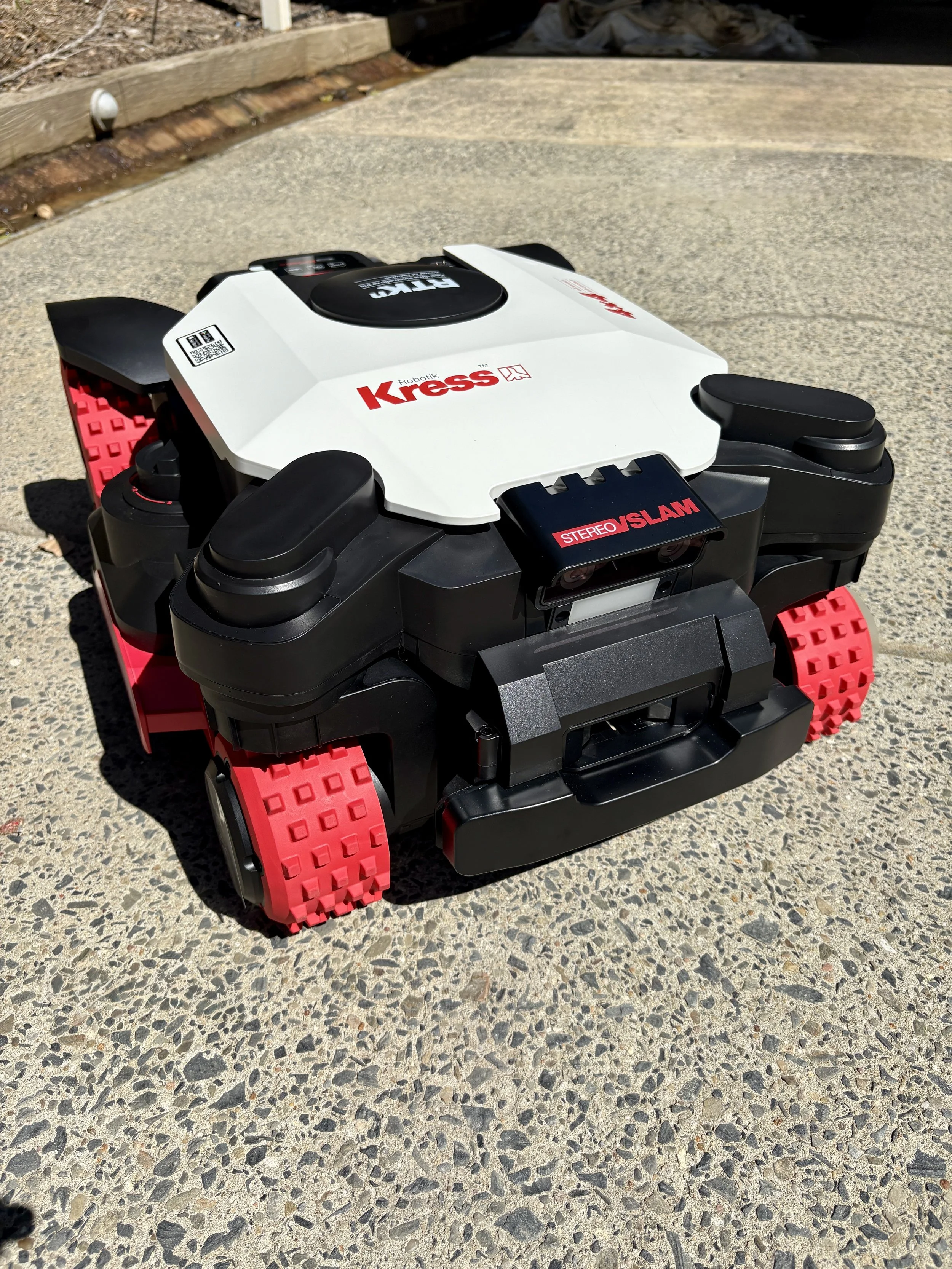
Advanced Kress implementation: Uses high-precision wheel encoders alongside IMUs and optical sensors to maintain centimeter-level accuracy even through long signal outages under thick tree cover.
4. Comparing Budget Consumer Mowers vs. Premium Kress Machines
Not all robot mowers are built to the same standard. Lower-priced consumer units often sacrifice hardware durability, network range, and positional precision. Premium Kress Robot mowers are powerful (bigger batteries, faster charging, bigger motors) and highly intelligent.
Navigation Network:
Cheap / Entry-Level Consumer Mowers - Local RTK base station (requires home setup, power, & clear line of sight) or require boundary wire.
Premium Kress Robot Mowers (RTKn Series) - Kress RTKn Network: No local base stations needed; connects directly to nationwide RTK network.
Signal Outage Handling
Cheap / Entry-Level Consumer Mowers - Basic or no dead reckoning (drifts quickly; gets lost under trees)
Premium Kress Robot Mowers - Advanced Odometry, Vision Systems & Inertial Guidance: Maintains accurate continuous mowing through dense canopies. Multiple layered systems allow for up to 15 minutes of accurate operation with no signal. No pauses, errors and able to operate within sheds and storage areas.
Mowing Pattern
Cheap / Entry-Level Consumer Mowers - Random ping-pong or basic lines subject to drift. Slower operation and missed patches.
Premium Kress Robot Mowers - Systematic Line-by-Line: Optimizes efficiency and reduces turf wear. Multiple patterns. remote height control, complex schedules. Edge trimming and AI Vision allows for very close edge mowing that other units just cant achieve.
Obstacle Avoidance
Cheap / Entry-Level Consumer Mowers - Bumper sensors or basic sonar. Will run over smaller items regularly
Premium Kress Robot Mowers - OAS (Obstacle Avoidance System): Intelligent AI camera/ultrasonic sensing - avoids most items before contact.
Build & Hardware Quality
Cheap / Entry-Level Consumer Mowers - Light plastic chassis, consumer-grade motors, short battery cycles. The machines are not serviceable and don’t last.
Premium Kress Robot Mowers - Commercial Heavy-Duty Build: Brushless motors, IPX5 waterproofing, long-life battery tech. Fully serviceable and repairable.
Terrain Capability
Cheap / Entry-Level Consumer Mowers - Mostly 2WD (struggles on steep or wet slopes)High-torque
Premium Kress Robot Mowers -2WD & AWD options capable of severe inclines without tearing turf
The Result:
Entry level machines just don’t have the power, intelligence and capability to give you perfect turf, week after week, year after year. At Lawn Loop we provide premium Kress Robotic equipment and diligent installation, and guarantee “Stadium Ready” perfection.